Birthday cake
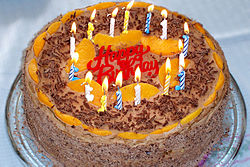
The practice of serving cake on birthdays is commonplace in many cultures. In contemporary Western cultures, birthday cakes for children are often topped with candles, secured with special holders or simply pressed down into the outer frosting. In the Anglosphere, the number of candles often corresponds to the age of the individual being celebrated, occasionally with one extra for luck.[4] An increasingly popular alternative is to use candles shaped as the numeral digits of the celebrant’s age. Sparklers may also be used alongside or instead of the traditional wax candles.
The cake is usually presented with all the candles lit, at which point it is customary for the guests to sing Happy Birthday to You in unison, or an equivalent birthday song appropriate to the country. Upon the conclusion of the song, the celebrant is traditionally prompted to blow out the candles and make a wish, which is thought to come true if all the candles are extinguished in a single breath. Another common superstition holds that the wish must be made in silence, not to be shared with anyone else, or else it will not come true.[5][6][7]
Sponge cake
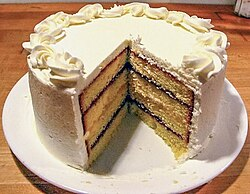
Sponge cakes (or foam cakes) are made from whipped eggs, sugar, and flour. Traditional sponge cakes are leavened only with eggs. They rely primarily on trapped air in a protein matrix (generally beaten eggs) to provide leavening, sometimes with a bit of baking powder or other chemical leaven added. Egg-leavened sponge cakes are thought to be the oldest cakes made without yeast.
Angel food cake is a white cake that uses only the whites of the eggs and is traditionally baked in a tube pan. The French Génoise is a sponge cake that includes clarified butter. Highly decorated sponge cakes with lavish toppings are sometimes called gateau, the French word for cake. Chiffon cakes are sponge cakes with vegetable oil, which adds moistness.[15]
Special-purpose cakes
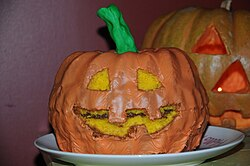
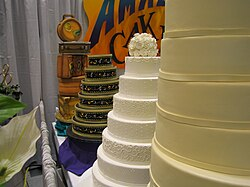
Cakes may be classified according to the occasion for which they are intended. For example, wedding cakes, birthday cakes, cakes for first communion, Christmas cakes, Halloween cakes, and Passover plava (a type of sponge cake sometimes made with matzo meal) are all identified primarily according to the celebration they are intended to accompany. The cutting of a wedding cake constitutes a social ceremony in some cultures. The Ancient Roman marriage ritual of confarreatio originated in the sharing of a cake.
Particular types of cake may be associated with particular festivals, such as stollen or chocolate log (at Christmas), babka and simnel cake (at Easter), or mooncake. There has been a long tradition of decorating an iced cake at Christmas time; other cakes associated with Christmas include chocolate log and mince pies.
A Lancashire Courting Cake is a fruit-filled cake baked by a fiancée for her betrothed. The cake has been described as “somewhere between a firm sponge – with a greater proportion of flour to fat and eggs than a Victoria sponge cake – and a shortbread base and was proof of the bride-to-be’s baking skills”. Traditionally it is a two-layer cake filled and topped with strawberries or raspberries and whipped cream.[20]
Sometimes a cake is made less for its value as food, and more for its value as a novelty. That includes the pop out cake, which is usually a large cardboard box, covered with cake or at least frosting. A person hides inside the box and jumps out as a surprise. A cake dress is a wearable dress that is made mostly out of cake (e.g., cake stacked on shelves attached to a crinoline skirt).